
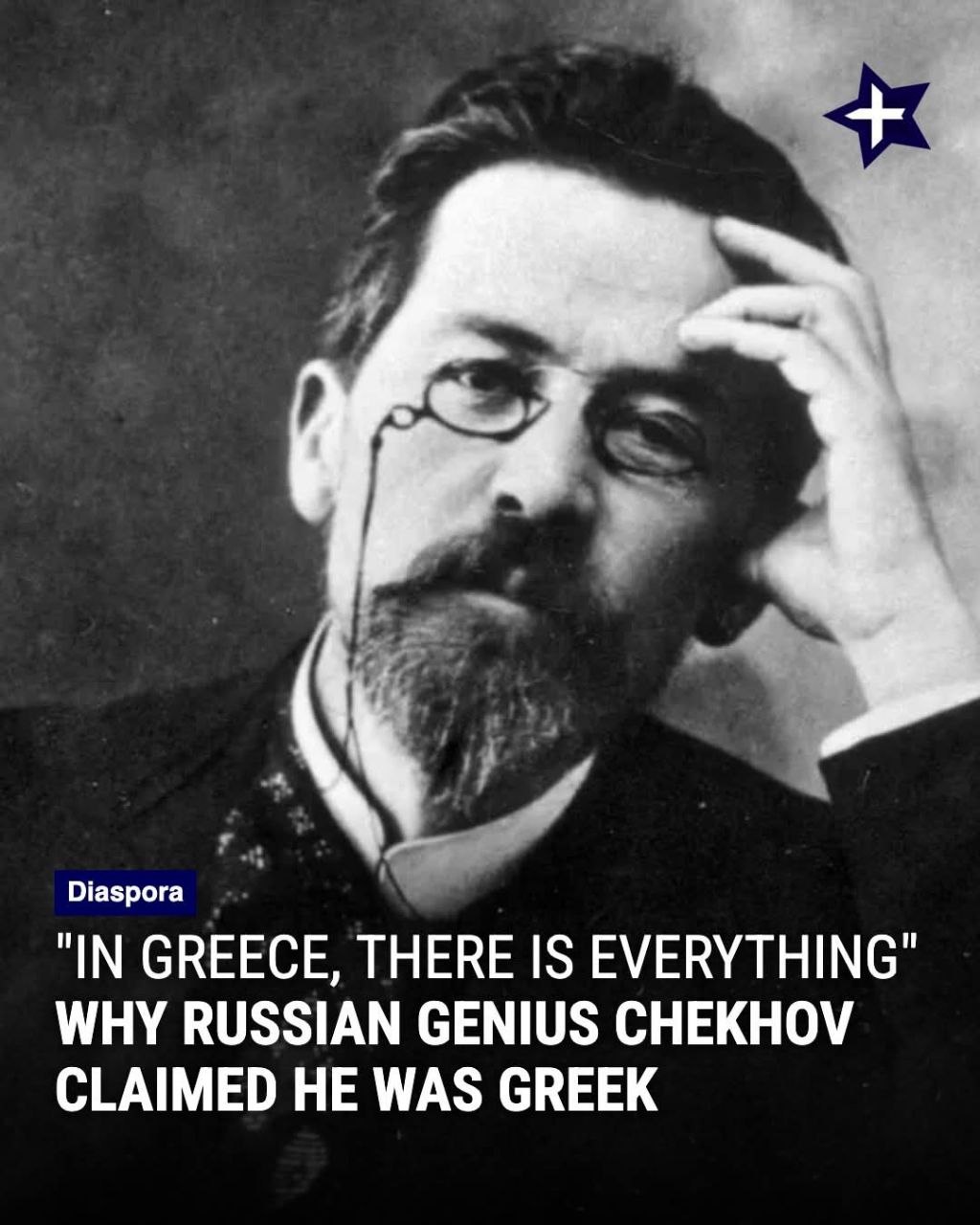
Anton Pavlovich Chekhov — one of the greatest writers in human history — looked in the mirror and saw a Greek.
Not metaphorically. He said it outright: “In Greece, there is everything.”
The man who revolutionized the short story and modern theatre was shaped by the Greek diaspora that thrived along the Black Sea and the Sea of Azov. Taganrog, his birthplace, was a bustling port city where Greek merchants, sailors, priests, and intellectuals built a thriving community. Chekhov grew up surrounded by Greek culture, Greek liturgy, Greek merchants, and Greek ideas about life, art, and the pursuit of meaning.
This is not a footnote in his biography. It’s the key to understanding him.
The Mediterranean soul of a Russian writer
Read Chekhov and you’ll feel it: the Mediterranean sensibility that runs beneath the Russian melancholy. His characters are obsessed with the same things Greeks have always been obsessed with — love, death, purpose, the passing of time, the beauty of a summer evening, the ache of unfulfilled potential.
Chekhov didn’t write like other Russians. Tolstoy had the epic scope of the steppe. Dostoevsky had the feverish intensity of St. Petersburg’s cramped apartments. But Chekhov? He wrote with the clarity of the Aegean light. Short, precise, devastating. He understood that tragedy and comedy are the same thing seen from different angles — a profoundly Greek insight.
The diaspora effect
The Greek diaspora was not a scattering. It was an expansion.
Wherever Greeks went — the Black Sea, Asia Minor, Alexandria, Marseille, New York — they carried the Mediterranean with them. They built churches, schools, newspapers, and libraries. They taught philosophy, medicine, and literature. They reminded everyone around them that civilization began in the sunlight of the Mediterranean, not in the fog of the North.
Chekhov absorbed this without even trying. The Greeks of Taganrog showed him that life is meant to be lived with intensity, humour, and a touch of fatalism. That a man sitting in a café arguing about politics is doing something meaningful. That the pursuit of beauty is not frivolous — it’s essential.
Why this matters to you
The Mediterranean Maxxing ideology is not about moving to a whitewashed village and posting sunset photos. It’s about recognizing that the Mediterranean way of life — community, conversation, passion, simplicity, reverence for beauty — is a philosophy that can be adopted anywhere.
If a Russian boy from Taganrog could become the world’s greatest short story writer because he was steeped in Greek culture, imagine what you can do by intentionally bringing Mediterranean values into your life.
- Talk to people. Really talk. Not small talk. Chekhov learned this in the Greek cafés of Taganrog.
- Pursue beauty. Not luxury. Beauty. A well-cooked meal. A well-told story. A sunset watched in silence.
- Embrace fatalism. The Greeks know that life is short and mostly outside your control. So laugh about it. Keep living anyway.
- Claim your heritage. You don’t need Greek blood to have a Greek soul. Chekhov proved that.
In Greece, there is everything
This is what Chekhov meant. Not that Greece has every product or service. But that Greece — the idea of Greece — contains every essential truth about how to live.
Beauty matters. Community matters. Passion matters. Laughter in the face of tragedy matters.
The Russian genius knew it. The Greek diaspora showed him.
Now you know it too.
Read the full source article here: Anton Chekhov and the Greek diaspora
Discover more from Mediterranean Maxxing
Subscribe to get the latest posts sent to your email.