
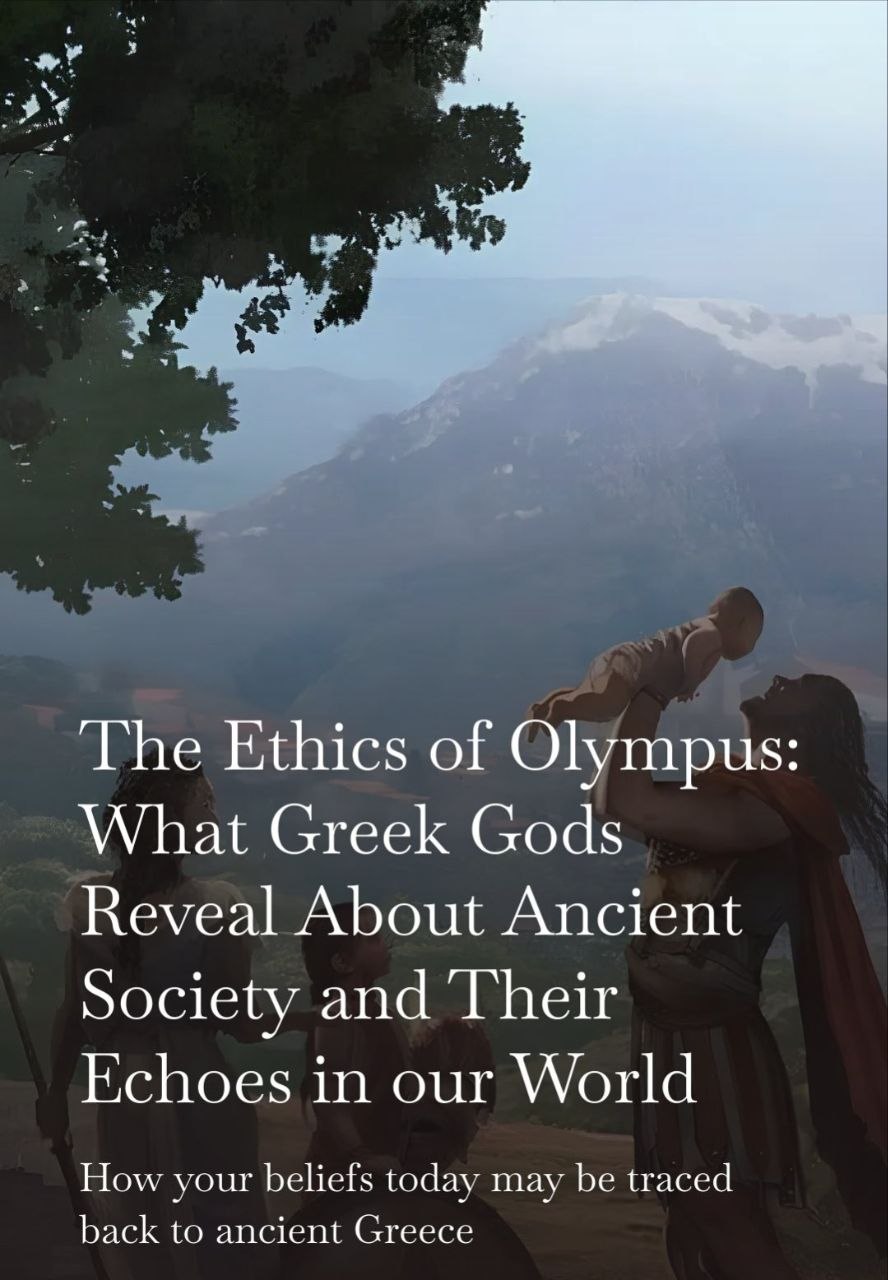
Open the Iliad to any page. You will not find a moral lesson neatly packaged for a classroom. You will find Achilles sulking in his tent, Hector kissing his son goodbye before a battle he cannot win, and gods who take sides in human wars because they are bored, offended, or in love. This is not scripture. This is something older and, in some ways, more honest: a mirror held up to what it means to be Greek — and by extension, what it means to be Western.
The Iliad and the Odyssey are not mere stories. They are not action-movie source material. They are a millenia-old codex of the Greek ethos, the cultural operating system that shaped the ancient world and, through it, the entire Western tradition.
A Pantheon of Flawed Gods
Unlike the sacred scriptures of other ancient civilizations, Greek religion had no single revealed text, no rigid commandments, no orthodoxy enforced by priests. What it had was a pantheon of anthropomorphic gods who were gloriously, recognizably human. Zeus was powerful but unfaithful. Hera was majestic but vengeful. Apollo was brilliant but prideful. Dionysus was ecstatic but dangerous.
These were not remote, abstract deities. They were personalities — beings you could argue with, bargain with, even trick. They mirrored human strengths and weaknesses, passions and flaws. And through this mirror, the Greeks developed a moral system rooted not in dogma but in lived values: reciprocity, order, excellence, moderation, and pragmatic wisdom.
How Worship Shaped Character
Ancient Greek religious practice was not about belief in the modern sense. It was about action. Sacrifices, festivals, oracles, processions, athletic games — these were the ways you participated in the divine order. You honored the gods not by reciting creeds but by performing rituals that reinforced the values of your community.
A sacrifice was a lesson in reciprocity: you gave to receive. An oracle was a lesson in humility: you did not have all the answers. An athletic festival was a lesson in arete — excellence — the pursuit of being the best version of yourself in body, mind, and spirit. The Delphic maxims — “Know thyself” and “Nothing in excess” — were not philosophical abstractions. They were practical guidelines for living well in a competitive, honor-driven world.
Ethos of the City-States
Ancient Greece was not a unified nation in the modern sense. It was a collection of city-states — Athens, Sparta, Thebes, Corinth — each with its own government, its own priorities, and its own fierce sense of identity. They fought each other as often as they fought outsiders.
But they were united by something deeper than politics: language, culture, religion, and a shared moral system. This is what the Iliad and Odyssey encoded. Every Greek child grew up hearing these stories. They learned that hospitality was sacred (the xenia that Odysseus depended on). They learned that pride could destroy you (Achilles’ wrath). They learned that cunning and endurance could save you (Odysseus’ long journey home).
These were not just entertainment. They were the curriculum of Greek identity.
The Gift to the West
When the Roman Empire absorbed Greek culture, it absorbed this moral system too. Roman education was built on Greek texts. Roman philosophy — Stoicism, Epicureanism — grew from Greek roots. When Christianity spread through the Roman world, it was interpreted through categories forged by Greek thought: logos, ethos, psyche, cosmos.
The Renaissance was a rediscovery of Greek sources. The Enlightenment was a conversation with Greek ideas about reason, democracy, and human excellence. The American founders read Plutarch and Aristotle. The modern university is structured around Greek categories of knowledge. The very idea that a citizen has rights and responsibilities — that is Greek.
You cannot understand the West without understanding the moral system the Greeks built. And you cannot understand that moral system without understanding the stories that encoded it.
What This Means for You
You were raised, whether you know it or not, in the shadow of these stories. The values you hold — individual dignity, the pursuit of excellence, the importance of moderation, the duty of hospitality, the belief that character matters — these are not universal human instincts. They are specific cultural inheritances. They came to you through a chain that runs back through Rome, through the Renaissance, through Byzantium, to the Aegean Sea and the oral poets who sang of Achilles and Odysseus.
Read the Iliad again. Not as a school assignment. Not as a fantasy epic. Read it as what it is: a manual for understanding who you are and why you think the way you do.
The gods are not dead. They are still arguing on Olympus. And their arguments are still shaping the world.
Discover more from Mediterranean Maxxing
Subscribe to get the latest posts sent to your email.