
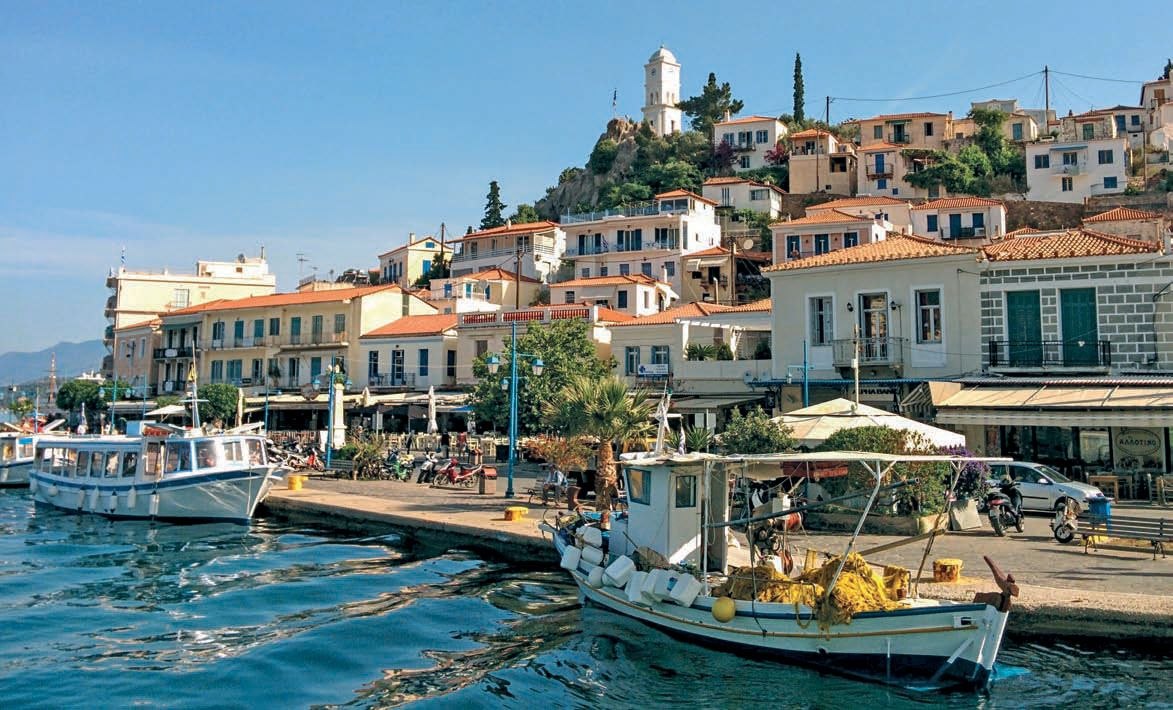
The ferry pulls away from Piraeus and within an hour, the city dissolves. The Saronic Gulf opens up — blue water, scattered islands, the Peloponnese coast rising to the east. Most tourists on this ferry are heading for Hydra or Spetses. They do not know about Poros. And you are glad they do not.
Poros is the secret the Athenians keep for themselves. An hour from the capital by ferry, it barely registers on the international travel radar. The crowds go elsewhere. The Insta-famous islands take the hits. Poros sits quietly in the channel between the Peloponnese and the open Aegean, doing what it has done for centuries: living a real Greek island life, unbothered.
The Arrival
The ferry slides into the narrow strait that separates Poros from the Peloponnese mainland. The channel is so narrow you feel like you could reach out and touch both sides. The town rises in a cascade of neoclassical buildings — pastel yellows, terracotta reds, whites that glow in the afternoon sun. A clock tower crowns the hill. Lemon trees hang over garden walls. The waterfront is a line of plane trees and cafés where nobody is looking at a phone.
You step off the ferry and the pace of your life drops by half. Not gradually. Instantly.
What Makes Poros Different
Poros is actually two islands — Sferia, the volcanic one where the town sits, and Kalavria, the larger, pine-covered island where the ancient ruins hide. A narrow causeway connects them. You can walk across in ten minutes and feel the landscape shift from bustling harbor town to silent forest.
Kalavria is where the ancient Temple of Poseidon stands, hidden in a grove of pines. This is where Demosthenes, the great Athenian orator, fled when the Macedonians came for him. He poisoned himself here rather than be captured. The temple ruins are not fenced off, not ticketed, not crowded. You walk through them alone, with the wind in the pines and the sea visible through the columns. It feels less like a tourist site and more like a place that simply has not forgotten its history.
The Swimming is Better Here
Poros does not have the dramatic beaches of the Cyclades. What it has is better: clear, calm water you can step into from the rocks, from the town itself, from any spot along the coast where the pines meet the sea. No long drives. No packed beach clubs. You walk down a stone path, find a flat rock, drop your towel, and swim.
The bay of Askeli has the organized beach if you want a sunbed. The coast near the Russian Bay is wild, with tamarisk trees providing natural shade. And on the Kalavria side, you can swim out from the Temple of Poseidon and float in water that has not changed since antiquity.
The Food is the Point
Poros has a proper fish market. The tavernas on the waterfront buy directly from the boats. You eat grilled octopus that was swimming twelve hours ago, served with a lemon squeezed by hands that have been doing this for forty years. The local specialty is savore — fresh fish fried and marinated in vinegar, garlic, and rosemary. It does not appear on tourist menus because tourists do not know to ask for it.
The island also grows its own lemons, olives, and almonds. Every meal comes with a view of the channel, the ferries sliding past, the lights of the Peloponnese twinkling across the water at dusk.
Getting There and Getting Around
The ferry from Piraeus takes 1 hour. Hydrofoils are faster (45 minutes) but run less frequently. You do not need a car — the town is walkable, and local buses cover the island. A bicycle is the ideal Poros vehicle: flat coastal roads, pine-scented air, and a taverna waiting at every stop.
You can also sail your own boat into the harbor and tie up along the waterfront quay. Poros has been a favorite yachting stop for decades — protected anchorage, easy provisioning, and a town that welcomes sailors without the premium prices of the more famous islands.
The Verdict
Poros is not trying to impress you. It does not need to. It has the deep, unforced beauty of a place that has been lived in for thousands of years and never felt the need to perform for visitors. The Athenians know this. They go there to reset, to eat well, to swim in water that feels like silk, and to remember why they live in this part of the world.
Now you know too. Keep it quiet.
Discover more from Mediterranean Maxxing
Subscribe to get the latest posts sent to your email.