
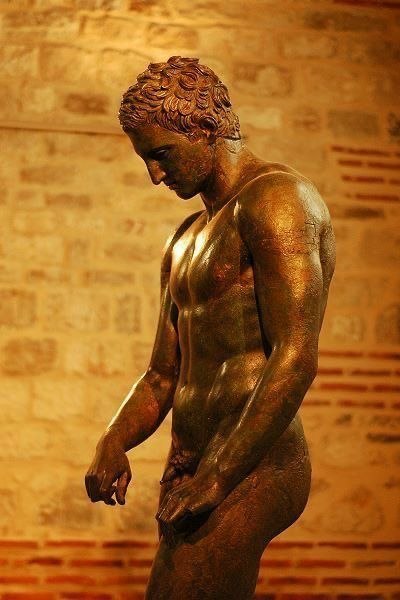
“The gods that surely exist but remain hidden have the most beautiful bodies we can imagine — they appeared to the ancient Greeks in dreams.”
This sentence, from an unknown source, contains more truth about ancient Greek religion than most textbooks. The Greeks did not believe their gods looked like mortals because they were naive. They believed it because they understood something about beauty that modernity has forgotten.
The gods of Olympus were not abstract spirits. They were beings of perfect form — bodies that represented the highest potential of the human physique, amplified to divine proportion. Apollo was not just the god of music and light. He was the eternal ephebe, the young man at the peak of his physical perfection, frozen in that moment forever. Aphrodite was not just the goddess of love. She was the female form at its most harmonious, the proportions so exact that no sculptor could fully capture them. Her statues are approximations. The real thing existed only in dreams.
Why the Greeks Saw Gods in Human Form
The Greeks were not projecting human limitations onto the divine. They were recognizing the divine in the human. For them, the body was not a prison for the soul. It was the most beautiful thing the material world could produce — and therefore the most fitting image for the immaterial.
A marble statue of a kouros — a nude male youth — was not pornography or idolatry. It was theology expressed in muscle and bone. The symmetry of the body, the proportion of the limbs, the balance of tension and relaxation in the pose — these were not aesthetic preferences. They were windows into the order of the cosmos. The same harmonic ratios that made a statue beautiful were the same ratios that governed the orbits of the planets and the cycles of the seasons.
When a Greek saw a perfectly trained athlete at the Olympic Games, he did not say “what a great body.” He said “he looks like a god.” The compliment was literal.
What Modernity Lost
Modern culture has a complicated relationship with the human body. It objectifies it commercially, hides it religiously, and medicates it clinically. It treats the body as either a tool to be optimized, a source of shame to be covered, or a machine to be repaired.
The ancient Greek view was different. The body was the visible expression of the soul. A beautiful body was not a random genetic gift. It was evidence of a life lived in harmony with nature — good food, daily movement, sunlight, discipline, and purpose. The Greeks did not need to “get in shape” because shape was a natural byproduct of how they lived.
A man who spent his days in the gymnasium, the palaestra, and the battlefield developed a body that reflected his character. A man who spent his days indoors, sitting, eating processed food, and staring at screens developed a body that reflected his character too. Both are honest. The difference is which character you want to reflect.
The Mediterranean Body Today
Walk through any Greek island town in summer. You will still see it — the old fisherman with shoulders shaped by decades of hauling nets, the grandmother who walks to the market every morning and has legs that could carry her another thirty years, the young men diving off rocks into clear water without a second thought.
These bodies are not gym-built. They are life-built. They come from swimming in the sea, walking on stone paths, eating food that came from the ground or the water that day, and sleeping in rooms with open windows. The Mediterranean lifestyle produces the Mediterranean body as a side effect — just as it produced the gods that appeared to the ancient Greeks in their dreams.
The Invitation
You do not need to believe in the old gods to understand what the Greeks were saying. The divine is not in the sky. It is in the proportions of a well-made body. It is in the way light falls on skin at golden hour. It is in the feeling of being alive, fed, rested, and in motion.
The gods appeared to the ancient Greeks in dreams because the Greeks were living in a way that made them capable of receiving the vision. They were healthy enough, strong enough, and still enough to see what modern life drowns out with noise.
The gods are still there. They are just waiting for you to live in a way that lets you see them.
Discover more from Mediterranean Maxxing
Subscribe to get the latest posts sent to your email.